

What if the dental crown you receive today could still be protecting your smile two or even three decades from now? It's completely natural to feel a bit of anxiety when you're told you need restorative work, especially when you're wondering how long does a dental crown last. You're making a significant investment in your health, and you want to be sure you won't be back in the dental chair for the same tooth in just a few years. We understand that you need more than just a quick fix; you need a solution that offers long-term stability and peace of mind.
In this guide, we'll reveal the real-world lifespan of modern restorations and share the expert habits that can help your crown endure for decades. While the typical lifespan often ranges from 10 to 15 years, many modern materials can last 20 to 30 years with the right care. We'll walk you through the differences between materials like zirconia and porcelain, explain why some crowns fail, and show you how a focus on precision diagnostics can protect your smile. You'll gain the confidence to choose the right material and the knowledge to make your investment last a lifetime.
Whether you are working with our local team or consulting with aesthetic specialists like Smile&Co., the goal remains the same: a healthy, radiant smile that stands the test of time.
Key Takeaways
- Understand how long does a dental crown last by exploring the difference between the 10-year industry average and the 30-year potential of modern materials.
- Compare the durability of various options, from high-strength zirconia to traditional gold, to find the most reliable restoration for your smile.
- Learn to identify the subtle signs of recurrent decay and why the precision of the initial fit is the most important factor in preventing failure.
- Discover a specialized daily hygiene routine and flossing techniques designed specifically to protect the structural integrity of your crown.
- See how our Maryville team uses digital X-rays and routine exams to monitor your restoration and ensure your dental work remains a long-term success.
The Average Lifespan of a Dental Crown in 2026
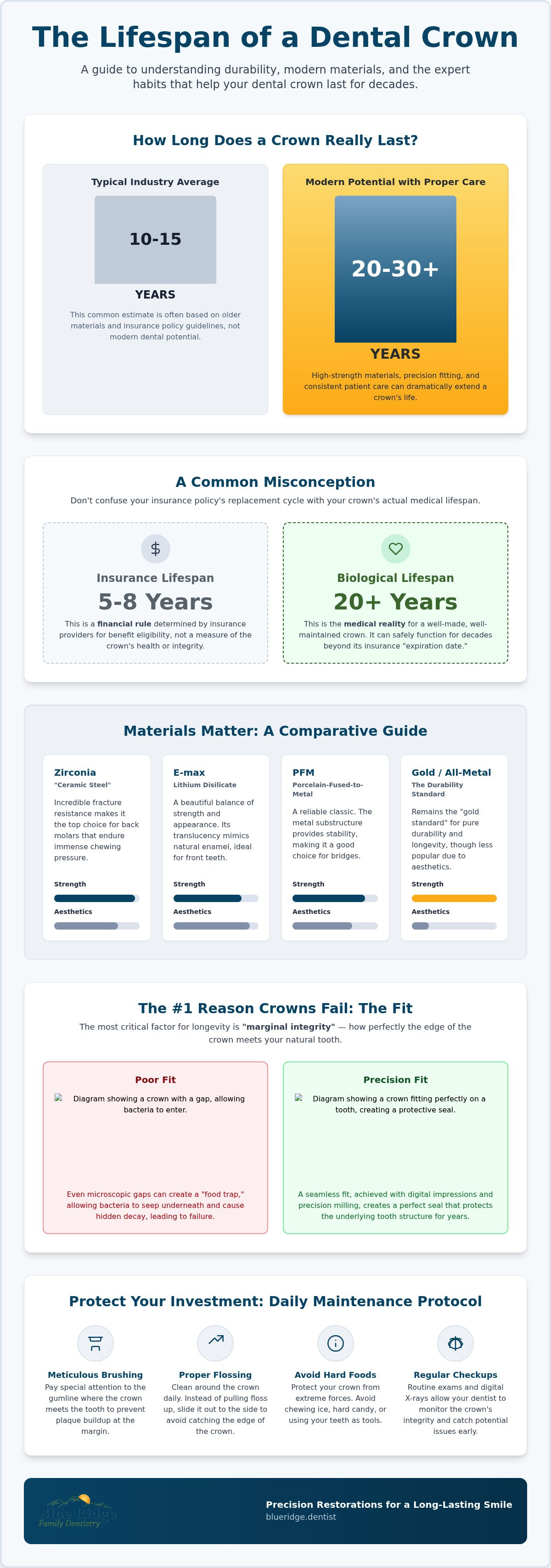
Many patients search for "how long does a dental crown last" and find a standard answer of five to fifteen years. While this estimate remains a common benchmark, it often reflects historical data rather than the modern reality of restorative dentistry in 2026. Material science has advanced rapidly, moving beyond basic porcelain to high-strength zirconia and advanced bonding agents that create a much more durable seal. We believe that a clinical setting should feel like a community home, where you can get honest answers about your long-term health. In our Maryville practice, we see success as a balance between function and aesthetics. A crown must not only look like a natural tooth but also withstand thousands of pounds of biting pressure over its lifetime.
The 10-to-30 Year Reality
Today, reaching the twenty-year milestone is a common goal for many of our patients. A Crown (dental restoration) is designed to act as a permanent shield, but its longevity depends on more than just the material itself. We often distinguish between the crown "failing," such as a chip in the ceramic, and the tooth needing a new restoration because of a new cavity at the margin. The lifespan of a dental crown is a variable of material, placement, and patient care. In many cases, the high-strength ceramics we use today can physically outlast the tooth structure they protect, provided the foundation remains healthy and free of decay.
Insurance vs. Biological Lifespan
Public perception is often skewed by dental insurance policies, which typically allow for a replacement every five to eight years. It's vital to understand that this is a financial rule, not a medical recommendation. Many patients ask our Maryville team how long does a dental crown last when they are reviewing their insurance benefits, and they're often surprised to learn the biological lifespan is much longer. Your crown can easily outlive its insurance "expiration date" by a decade or more. At Blue Ridge Family Dentistry, we use digital X-rays to monitor the integrity of your restorations during routine checkups. This allows our team to verify that the seal is still intact and the tooth underneath is healthy, even if the crown was placed years ago. We focus on preserving your existing work whenever possible, emphasizing that a well-maintained crown is a long-term investment in your overall well-being. By catching small issues early during regular exams, we help ensure your restoration reaches its full potential.
Materials and Placement: The Building Blocks of Longevity
Choosing the right material is the first step in ensuring your restoration stands the test of time. While the average lifespan of a dental crown is often cited as a decade, the specific material used for your tooth can push that number much higher. In our Maryville office, we don't just look at the tooth in isolation; we consider its location in your mouth and the way your teeth come together when you chew. A molar at the back of the mouth requires much higher durability than a front tooth, where aesthetics are the primary concern. Our team is here to guide you through these choices with a focus on your long-term comfort and health.
Zirconia and E-max: The Modern Standards
Zirconia has revolutionized restorative dentistry, earning the nickname "ceramic steel" for its incredible fracture resistance. It's the preferred choice for back molars because it can withstand the immense pressure of grinding and chewing without chipping. For teeth that show when you smile, Lithium Disilicate, commonly known as E-max, offers a beautiful balance. It provides high-end aesthetics with a translucency that mimics natural enamel, yet it remains strong enough for daily function. While all-metal or gold crowns remain the gold standard for pure durability, many patients prefer the natural look of porcelain-fused-to-metal (PFM) or full ceramic. PFM crowns are still a reliable, classic approach for bridges where a metal substructure provides necessary stability over a longer span.
For those interested in how modern technology and expert care come together to maximize the life of these materials, you can learn more about Dental11 and their approach to restorative excellence.
The Importance of Precision Fit
The most critical factor in determining how long does a dental crown last isn't just the material; it's the "marginal integrity." This refers to how perfectly the edge of the crown meets your natural tooth. If there's even a microscopic gap, bacteria can seep underneath, leading to decay that remains hidden from view. We use digital impressions and precision milling to ensure a seamless fit, which eliminates "food traps" and protects the underlying tooth structure. Modern dental cements also play a vital role, creating a permanent chemical bond that seals the tooth from the outside world. This superior structural support is one reason a crown is often the better investment for a compromised tooth, as you can see in our comparison of a dental crown vs. filling.
We also carefully evaluate the relationship between your new crown and your opposing natural teeth. A crown that's too hard can actually wear down the enamel on the teeth it bites against. Our goal is to create a harmonious bite that feels natural and keeps your entire smile healthy. If you're curious about which material is right for your unique needs, our compassionate team at Blue Ridge Family Dentistry is ready to schedule a comprehensive exam to discuss your options.
Why Dental Crowns Fail: Addressing the #1 Concern
Understanding the risks to your restoration is the best way to protect your investment. While you may naturally wonder how long does a dental crown last, the answer often depends on whether you're facing a biological issue or a mechanical one. It's helpful to distinguish between a crown that has physically broken and a tooth that has developed a new problem underneath. At our Maryville practice, we focus on identifying these risks early to prevent a simple fix from becoming a complex procedure. We want you to feel empowered and informed about your oral health, knowing that many failures are entirely preventable with the right habits.
Biological Failure: Decay and Gum Disease
The most common "silent killer" of dental work is recurrent decay. This happens when bacteria find a way to settle at the margin where the crown meets your natural tooth. While the crown itself cannot get a cavity, the tooth structure holding it in place certainly can. The crown is artificial, but the supporting tooth is still living tissue. If a cavity forms at this junction, it can undermine the entire restoration, even if the porcelain looks perfect on the surface. Similarly, periodontal disease can cause the gums and bone to recede. This loss of foundation leaves the tooth vulnerable and can eventually cause the crown to become unstable. Regular cleanings are essential because they allow us to remove plaque from these hard-to-reach areas.
Mechanical Failure: Fractures and Debonding
Mechanical issues usually stem from excessive force or wear. Bruxism, or chronic teeth grinding, is a leading cause of fractures. Over time, the constant pressure can create microscopic cracks in ceramic materials that eventually lead to a visible break. There is also a difference between a crown breaking and one "popping off," which we call debonding. Debonding often occurs when the dental cement reaches the end of its life or if the underlying tooth has changed shape due to new decay. In many cases, a crown that falls off can be cleaned and recemented if the tooth underneath remains healthy and intact.
Lifestyle habits also play a major role in the average lifespan of a dental crown. Using your teeth as tools to open packages, bite nails, or chew on ice creates "heavy spots" of pressure that can shatter even the strongest porcelain. A misaligned bite can also contribute to this, as one tooth may be taking more force than it was designed to handle. We take great care during our exams to check your bite alignment, ensuring that your dental work remains a stable and comfortable part of your smile for years to come. By treating your restorations with care, you help them last for the long haul.
Daily Maintenance Protocol to Extend Crown Life
Once your restoration is in place, your daily habits become the true warranty for your smile. While materials like zirconia are incredibly strong, the way you clean and protect them determines how long does a dental crown last in a real-world environment. We want to help you move beyond basic brushing to a routine that specifically targets the vulnerable areas of your dental work. By adopting a few expert techniques, you can ensure your crown remains a stable and beautiful part of your life for decades.
The Right Tools for the Job
Cleaning the margin where the crown meets the gumline requires precision. Electric toothbrushes are often superior to manual ones because their consistent, high-speed vibrations effectively disrupt biofilm without requiring aggressive pressure. It's also vital to use non-abrasive toothpastes. Many whitening formulas contain gritty particles that can dull the polished glaze of your porcelain over time, making it more susceptible to staining. For those with bridges or multiple crowns, a water flosser is a game-changer. These devices use a targeted stream of water to flush out debris from under bridge spans and tight spaces that traditional floss might miss.
Protecting Your Investment from Stress
Mechanical stress is a leading cause of premature wear. If you have a habit of clenching your teeth at night, a custom-fitted night guard is the best insurance policy you can buy for your dental work. This simple device acts as a shock absorber, preventing the intense pressure of bruxism from fracturing the porcelain. Your diet also plays a significant role. We recommend avoiding the "Sticky and Hard" list, which includes items like ice, hard candy, and taffy. These substances can either shatter the ceramic or create enough suction to pull a crown loose from its cement bond.
Regular professional monitoring is the final piece of the puzzle. During a Comprehensive Dental Exam in Maryville, we check for early signs of wear or marginal gaps that you can't see in the mirror. Catching a small issue during a routine visit can save you from a complete replacement later. If you haven't had your restorations checked recently, we invite you to contact Blue Ridge Family Dentistry to ensure your smile stays on the right track.
The Blue Ridge Approach: Precision Restorations in Maryville
At Blue Ridge Family Dentistry, we believe that high-quality clinical care should feel like visiting a trusted neighbor. Our approach to restorative dentistry is rooted in a commitment to both technical excellence and your personal comfort. We know that the secret to how long does a dental crown last isn't just found in the laboratory, but in the precision of the diagnostic tools we use right here in our Maryville office. By combining advanced technology with a conservative philosophy, we aim to protect your natural smile while providing restorations that stand the test of time.
Diagnostic Excellence with Digital X-Rays
The foundation of a long-lasting crown is a healthy tooth underneath. To ensure your restoration remains secure, we utilize high-resolution digital X-rays to monitor the "invisible" areas where the crown meets your natural tooth. These advanced images allow us to catch "micro-leaks" or tiny areas of decay before they can turn into major failures. While a physical exam is important, these digital tools provide the deep insights necessary to answer how long does a dental crown last for your specific situation. We view these regular diagnostic checkups as the real "warranty" for your dental work, giving us the chance to verify that the seal is tight and the foundation is strong. This proactive monitoring is a cornerstone of our practice, helping our Maryville and Alcoa patients avoid unexpected repairs and maintain their oral health with confidence—much in the same way proactive homeowners explore HVAC Installation & Repair to prevent system failures before they start.
Compassionate Care for Maryville and Alcoa
We understand that every patient comes to us with different needs, budgets, and levels of dental anxiety. Our team takes the time to listen to your concerns, tailoring our material selections and treatment plans to fit your unique lifestyle. We follow a philosophy of conservative dentistry, which means we always strive to save as much of your natural tooth structure as possible. This approach not only makes the procedure more gentle but also provides a more stable base for your new crown. Our office is designed to be a welcoming, anxiety-free environment where you can feel at ease from the moment you walk through the door.
Whether you're replacing an old restoration or need a new one to protect a damaged tooth, we're here to provide the neighborly, professional service you deserve. We take pride in being a stable fixture in the Maryville community, offering sophisticated care with a person-centered touch. If you're ready to explore your options for a durable, beautiful smile, we invite you to schedule your restorative consultation at Blue Ridge Family Dentistry today. Let us help you make an investment in your health that lasts for decades.
Protecting Your Smile for Decades to Come
A dental crown is more than just a repair; it's a structural investment in your daily comfort and confidence. While the answer to how long does a dental crown last depends on high-quality materials and a precision fit, the most important factor is consistent, professional care. By choosing durable options like zirconia and maintaining a diligent hygiene routine, you can help your restoration reach its full potential of twenty years or more.
Our team of four lead dentists at Blue Ridge Family Dentistry is dedicated to providing expert restorative care in a compassionate, neighborly environment. We use advanced digital X-ray technology to monitor your restorations with precision; this helps us catch small issues before they impact your health. Whether you need a new restoration or a checkup on existing work, we're here to be your stable partner in dental wellness. We look forward to helping you maintain a healthy, confident smile for a lifetime.
Book Your Restorative Consultation in Maryville Today
Frequently Asked Questions
Can a dental crown last 30 years?
Yes, it's possible for a dental crown to last 30 years or more with meticulous care. While many people ask how long does a dental crown last and expect a shorter timeframe, durable materials like gold or high-strength zirconia can endure for decades. Success depends on your daily hygiene and factors like whether you grind your teeth. Regular monitoring at our Maryville practice ensures the seal remains intact to protect your tooth for the long term.
What are the signs that a dental crown needs to be replaced?
Common signs include persistent pain when biting, visible chips in the porcelain, or a dark line appearing at the gumline. You might also notice a slight movement or a feeling that the crown is loose. These symptoms often indicate that the cement bond has weakened or decay has formed underneath. If you notice any changes in how your crown feels, it's a good idea to have it evaluated by our team to prevent further damage.
Is it normal for a dental crown to feel sensitive to cold?
Mild sensitivity to cold is common for a few days after your crown is placed. This typically happens because the tooth was prepared and the nerve is responding to the procedure. However, if the sensitivity lasts for weeks or becomes sharp and painful, it could indicate a high spot on your bite or an issue with the nerve. We can easily adjust your bite to alleviate this discomfort during a quick, gentle visit to our office.
What happens if a dental crown falls out?
If your crown falls out, you should keep the restoration and call us immediately to schedule an appointment. Avoid trying to glue it back yourself with household products, as this can damage your tooth and make a professional repair more difficult. In many cases, if the crown and the underlying tooth are still healthy, we can clean and recement the original restoration. Prompt action prevents the exposed tooth from shifting or becoming sensitive to bacteria.
Can you get a cavity under a dental crown?
Yes, you can develop a cavity under a crown, specifically at the margin where the artificial material meets your natural tooth. While the crown itself is immune to decay, the living tooth structure underneath is still vulnerable to plaque. This is why the answer to how long does a dental crown last is so closely tied to your daily flossing habits. Our team uses digital X-rays to detect these hidden cavities before they cause significant pain or structural failure.
Does a dental crown look different from natural teeth?
Modern restorations are designed to blend seamlessly with your surrounding smile. Materials like E-max and zirconia mimic the translucency and color gradients of natural enamel, making them virtually indistinguishable to the naked eye. We carefully match the shade of your new crown to your existing teeth during the planning phase. This ensures that your smile looks healthy and uniform, providing a result that is both functional and beautiful for our Maryville patients.
How much does it cost to replace an old dental crown?
The cost to replace a crown depends on the material you choose and the complexity of removing the old restoration. Most dental insurance plans cover a portion of the replacement cost if the existing crown is over five to eight years old and is no longer functional. We recommend checking your specific benefits with your provider to understand your out of pocket costs. Our team is always happy to help you understand your coverage and provide a clear estimate before treatment begins.
Can a cracked dental crown be repaired without replacing it?
Small chips in the porcelain can sometimes be smoothed or polished without removing the crown. However, if the crack is deep or affects the structural integrity of the restoration, a full replacement is usually the safest option. A compromised crown can allow bacteria to reach the tooth underneath, leading to decay or infection. We prioritize conservative care and will only recommend a replacement if it's truly necessary to protect your oral health and the stability of your smile.


